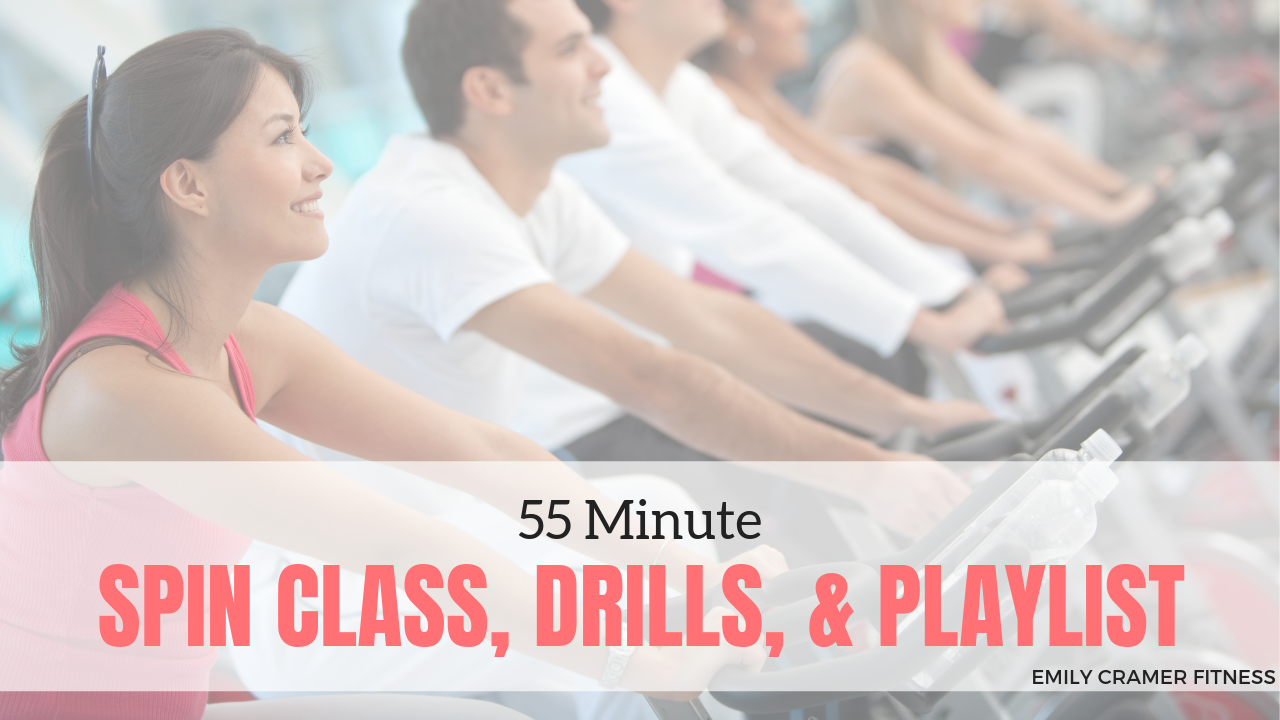
55 Min Spin Class Routine, Drills, and Playlist
If you've never tried a spin class before, you're missing out! I'm a little biased as teach 2-5 spin classes each week but I promise you, you won't regret it if you give it a shot!
The Benefits of Spin
Spin is a great form of cardio. It's lower impact than running and supports muscle building rather than working against it. For the entirety of the workout, you're challenging yourself with gear on the bike, which helps you build strong quads, hamstrings, glutes, and core.
As a bikini competitor (currently in my improvement season), my goal is to add muscle size to my legs so it's vital that I choose my cardio wisely. I've found that cycling has had little to no effect on my ability to build my legs while also helping me to burn major fat.
There's also a fabulous sense of community in an indoor spin class. You'll notice you feel a lot more motivated to push yourself when you look around the room and see people of all ages, sizes, and activity levels working so hard.
And of course, spin wouldn't be complete without a killer playlist. If it's curated correctly, you should almost forget you're working out and start feeling like maybe you're out at a club on a Friday night with a group of fit girlfriends, all dancing to the rhythm of the upbeat party music.
DIY Spin Class
Whether or not you decide to sign up for a class, you can totally hold a class all by yourself! I've included one of my recent playlists so you can give it a shot yourself.
Get ready to break a serious sweat!
(Don't worry! The drills are explained below the workout so you can follow along even if you've never been on a spin bike.)
The Drills Explained
Warm Up
During our warm up we always do some light pedaling and some upper body stretches. We stretch the lats, shoulders, triceps, wrists, and chest. As we moved into the second song of this playlist, we took our warm up a step further and completed 30 seconds in several RPM ranges:
90-100 RPM
80-90 RPM
70-80 RPM
60-70 RPM
With each 30 second interval, we added gear to the bike to bring us into the new RPM range.
Jumps
During jumps, I advise the group to take their gear to a 6 on a scale of 1-10 rating their perceived exertion (10 being the most intense, heaviest gear they can put on the bike and pedal at 60 RPM)
We transition from pedaling in the seat to standing, and then back to the seat.
These transitions should always feel slow and controlled.
Don't use your body's momentum to transition. Keep the core tight and push up and down with your legs.
Sprints
When we sprint, I encourage riders to find 100-110 RPM. Any higher than 110 RPM puts unnecessary pressure on your knees and can cause you to lose control of your pedal stroke.
If you find yourself bouncing up and down when sprinting in the saddle, raise your gear a little bit.
If you find yourself pumping with your upper body to get through each pedal stroke, lower your gear a bit.
Climbing
When we climb, we most often take our RPM to 60-70 RPM. This allows us to put some nice heavy gear on the bike.
Don't let your RPM fall below 60. This, again, isn't safe for your knees.
As with sprints, if you find yourself pumping with your upper body, take some gear off the bike.
If you're in a standing climb, hands should travel to hand position 3, which means they are wrapped around the very top of the handle bars. Keep your back flat and your hips back over the saddle for hamstring activation and proper form.
Rolling Hills
When we incorporate rolling hills, the group climbs uphill (usually finding their 8 on a 1-10 scale of perceived exertion). Then on the way down, we lower the resistance until they find their RPE 6 and we speed up.
Sometimes we stand uphill and sit downhill. Sometimes we do the reverse. Sometimes we do a whole hill standing and a whole hill seated.
Feel free to get creative and spice it up each time you try this drill!
30/20/10 Drills
This is currently my FAVORITE drill! It's amazing and the class really enjoys it... maybe we all have a love/ hate relationship with it. Haha!
We want to maintain 80-110 RPM for the WHOLE song. It will get harder as the song progresses.
For 30 seconds, we find our 6 gear wise on a scale of 1-10 (10 being the most gear we can handle for 60 RPM.) This means nice, moderate gear.
Once 30 seconds is up, we add 2 gears to the bike and speed up for 20 seconds.
At 20 seconds, we add 4 gears to the bike and perform at max output for 10 seconds.
Then we return to our 30 seconds of moderate gear.
We rotate through these intervals for the duration of the song.
Cool, right?!
Cool Down
We take the gear back down for the cool down and take a water break while continuing to pedal. Once the heart rate starts coming down, we do some of the upper body stretches from our warm up.
Then we dismount the bike. We do standing quad, hamstring, and glute stretches.
Always make sure to also do some foam rolling post class for optimal recovery!
And that's it!
I hope you enjoyed this and give this workout a shot on your own!
Ready to transform your body, health, and confidence with online personal training and nutrition coaching for women—without your life revolving around fitness?
Emily Cramer Fitness offers 1:1 online fitness and nutrition coaching for women who want to lose fat, build muscle, and finally stay consistent without all-or-nothing thinking.
This coaching is for you if:
✔ You want a personalized workout and nutrition plan that fits your real life
✔ You’re tired of starting over and want sustainable fat loss and muscle building
✔ You want to feel confident, strong, and energized—not restricted or burnt out
✔ You want expert guidance, accountability, and support every step of the way
There will never be a perfect time to start. Confidence comes after you take action—and every small step forward brings you closer to the life you want.
Not sure if it could work for you?
Check out my Client Success Stories—real women, real results.
👉 Apply now to see if 1:1 coaching is the right fit for you.
Applications are reviewed personally, and accepted applicants will be invited to a call to discuss goals and next steps.
Still have questions?
You’re not alone—here are the most common ones I hear from women considering 1:1 coaching.
Frequently Asked Questions
Q: Do I need to already be fit to apply?
A: Not at all. My clients come from all different starting points. What matters most is your willingness to be consistent and open to learning—not where you’re starting from.
Q: How does online personal training and nutrition coaching work?
A: You’ll receive a fully personalized workout and nutrition plan, ongoing support, and regular check-ins—all delivered online so it fits into your schedule and lifestyle.
Q: Do I need access to a gym?
A: Nope! Programs can be customized for home workouts or gym workouts. I tailor the program to whatever equipment you have available.
Q: Is this a meal plan?
A: This isn’t a restrictive or generic meal plan. I teach you how to eat in a way that supports fat loss, muscle building, and long-term consistency—without cutting out foods you love.
Q: How long is the coaching commitment?
A: This is a 1:1 coaching experience designed to create lasting change. Commitment length and details are discussed during the application call to ensure we’re the right fit.
Q: How do I get started?
A: Simply apply through the coaching application. If accepted, you’ll be invited to a call to talk through your goals, answer questions, and see if coaching is right for you.
To Your Health & Success,